Saturday, 26 March 2016

Twinkle Khanna: The Patriot Games, and why we’re all losing

[ad_1]


[ad_2]

Actual source

Rise of the other N-word

[ad_1]

George Orwell saw it as a hunger for power “tempered by self-deception.” Albert Einstein called it an “infantile disease…the measles of mankind.” Nationalism is like cheap alcohol, said Dan Fried, a US scholar-diplomat who saw the birth of many new nations in Europe during his watch at the State Department: first, it makes you drunk, then it makes you blind, and then it kills you. In the US itself, the writer Sinclair Lewis warned that when fascism — the more extreme big brother of nationalism — comes to America, “it will be wrapped in the flag and carrying a cross.” Geography and religion form the potent mix for most nationalism.


Scholars and savants, sociologists and political scientists, across ages and across continents, have cautioned against rampant nationalism and its close cousin patriotism (famously described by Mark Twain as the “last refuge of a scoundrel”). But in country after country, from America to Europe to Asia, nationalistic fervor is all the rage, fuelled by everything from border disputes to sporting rivalry, from trade protectionism to cultural expansionism. The latest to join the list of triggers that spark patriotic and nationalistic outrage (always expressed loudly rather than quietly): terrorism.


Consider this: More than a million infants die every year of malnutrition and more than 100,000 youngsters are killed in road accidents every year in India — doesn’t evoke an iota of embarrassment from the nationalistic brigade. There are some 30,000 casualties from gun violence in the US every year, including more than 300 instances of mass shooting in 2015. No nationalistic outrage. Both are shrugged off. But a single terrorist attack, particularly if it comes from a perceived foreign source, can trigger a nationalistic outpouring that can dominate the media for days and weeks.


Every death is different, and indeed every terrorist attack is different, depending on its geography and its victims. While America and Europe fret about terrorist incidents in their territory, provoking nationalistic fury, there is little concern for terrorist attacks in distant India. Within India itself, a terrorist attack in Delhi or Mumbai has a different resonance from the one in Dantewada or Aizawl, which are outside national — and nationalistic — mainstream conscience. And no one cares for attacks in Africa, including within Africa itself: Burkina Faso, Mali, and Ivory Coast have all seen attacks as bloody and lethal as the ones in Brussels and San Bernardino without getting a fraction of the coverage.


All this is broadly in tune with the first principles of patriotism (when love of your people comes first) and nationalism (when hate for people other than your own comes first). The difference between patriotism and nationalism, explained the late American columnist Sydney Harris, is that the patriot is proud of his country for what it does, and the nationalist is proud of his country no matter what it does. The first attitude creates a feeling of responsibility, but the second a feeling of blind arrogance that often leads to war, as has been demonstrated again and again in history.


But increasingly — as evident in India, the US, and even in Europe — nationalism is coming to be identified with one religious or racial or ethnic constituency at the expense of others who are different in number or belief or influence. They are also taking on newer slogans — Donald Trump’s Make America Great Again — to address contemporary insecurities, or building on slogans that originally invoked God and Country — Bharat Mata ki Jai.


It seems a dreadful indignity to have a soul controlled by geography, said the philosopher George Santayana — but it has only increased with greater migration and interaction that one expected would makes national boundaries less relevant. Both America and Europe, which seemed to have elevated themselves to a more genteel form of civic nationalism that transcended ethnic or racial identity, are quickly returning to identity-based nationalism as their largely white Anglo-Saxon populations feel the pressure of immigrants, mainly coloured people, crossing borders looking for a better life.


A quarter century ago, the world seemed to be breaking down walls and countries appeared to be transcending their narrow national identity to form continent-sized (trading) blocks. Suddenly, along with the new slogans, walls are coming up everywhere…from India’s fencing of borders with Pakistan and Bangladesh, to Israel’s notorious wall against Palestine, to Trumpistan’s proposed wall on the border with Mexico.


One Internet meme that surfaced on social media after Wednesday night’s thrilling cricket match against Bangladesh captured the new mood. It showed the now famous photo-finish of India’s captain running out the Bangladeshi batsmen six inches short of the batting crease. The caption read: MS Dhoni doing what Mamata Banerjee cannot do — preventing a Bangladeshi from crossing the border.


DISCLAIMER : Views expressed above are the author's own.


[ad_2]

Actual source

How the gentle ascetic figure of Bharat Mata morphed into an ultra-nationalist warrior

[ad_1]

Whether you are a historian, a collector of bazaar art, an analyst of visual culture or just plain curious, the iconography of Bharat Mata makes for a fascinating study. The many small details it packs, the backdrop, the colours, the subtext, the jewellery and costume, everything tells a story.
Historian Sumathi Ramaswamy’s seminal book The Goddess and the Nation, Mapping Mother India shows how Bharat Mata has been reimagined over the years, going from a benign, giving figure or a tragedienne to a martyr and often an ultra-nationalist warrior.
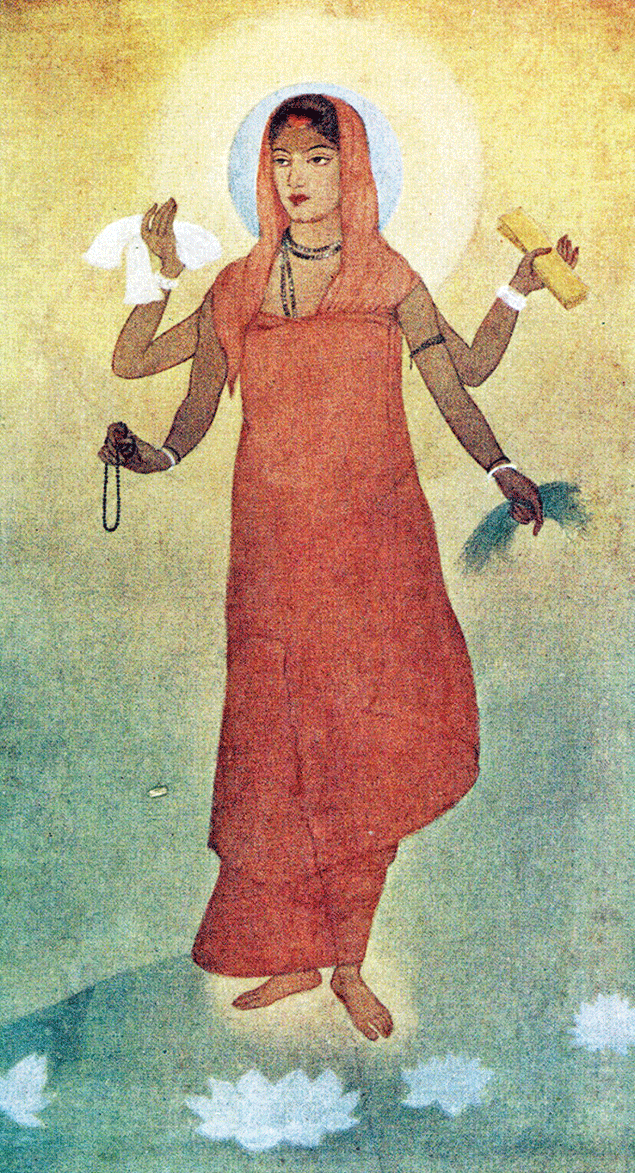
Among the first of these was the famous rendering by Abanindranath Tagore in 1905. His Bharat Mata is a four-armed woman dressed like a sadhvi with a beatific look on her face. But in mass-produced calendar images, as Ramaswamy points out, Mother India did not sport the ascetic look; instead, she wore vivid, flowing saris, often sported a jewelled crown, carried arms (cover image) and was flanked by roaring lions.
‘Mother’ makeover: Abanindranath Tagore’s interpretation in 1905. (Photo Credit: OSIAN’S Archive Research & Documentation Centre, Mumbai)
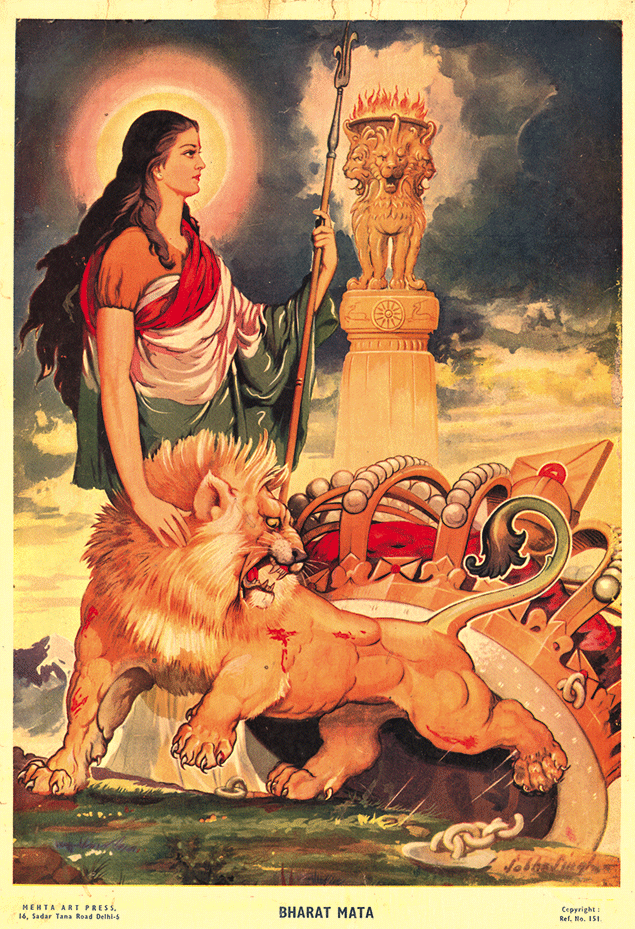
A poster published around 1950 and signed by Sikh painter Sobha Singh shows Bharat Mata flanked by a lion (page 64, figure 37). Ramaswamy theorizes that the number of lions flanking her — a predator associated both with Durga and the British Empire — and their ferocity increased as the freedom movement headed towards a successful conclusion. With the passage of time, Mother India was being mapped along with towering figures of the freedome movement such as Gandhi, Subhas Chandra Bose, Nehru and Sardar Patel, paying obeisance, cutting her shackles and often sitting on her lap. This infantilized position is given to both Bose (page 213, figure 105) and Gandhi.
A more ferocious avatar painted by Sobha Singh in 1950. (Photo Credit: Erwin Neumayer and Christine Schelberger, Vienn)
Among the many post-independence visuals that Ramaswamy uses is the cover of right-wing activist Dinanath Batra’s “inspirational” book Ma ka Aahvaan (page 43, figure 23). Published in 1996, it shows her against a fiery backdrop with an explosion of some kind going off in the general direction of the north-west. Amusingly enough, as the scholar points out, the artists take cartographic licence. So her bellowing pallu, halo, crown or long hair might sweep up Pakistan, the toes might stick into Sri Lanka and her arms extend into Bangladesh.
The most controversial rendering of Bharat Mata was M F Husain’s 2004 painting of an unclothed female form mapped on to India which forced him into self-imposed exile in the wake of violent threats from the right wing.


[ad_2]

Actual source

Who’s better: Sachin or Virat?

[ad_1]

It’s like asking who’s superior: Diego Maradona or Lionel Messi? To millions of devoted fans, Tendulkar will always be the god of Indian cricket. Of late, however, Kohli’s divine, match-winning knocks have earned him cult status among his admirers.
The truth is, there can be no fair, defi nitive answer to the query. The two careers overlapped a bit. But remember: pitches, bowlers, batting equipment, rules – all have changed dramatically since 1989, when Sachin played his fi rst Test and ODI.
Yet comparisons are both inevitable and exciting. To be fair, though, let’s keep T20 out of this. Sachin played only one T20 international in his entire career. That too when he was already 34. So the comparison must restricted to Tests and ODIs, based on the number of innings played by Kohli till now. Sunday Times trawls an ocean of statistics to bring a complete comparative picture of the two batsmen.
Sachin is better in Tests
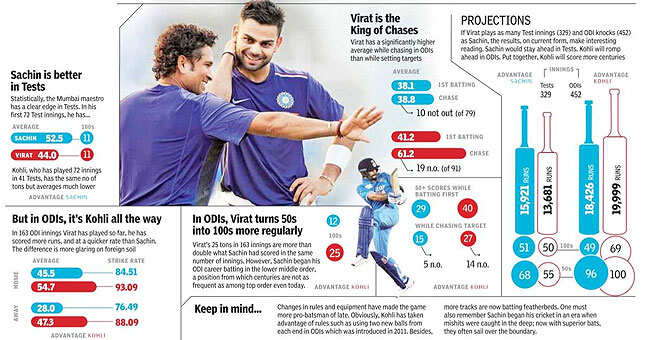
Statistically, the Mumbai maestro has a clear edge in Tests. In his first 72 Test innings, he has..
Average 100s
Sachin 52.5 11
Virat 44.0 11
Kohli, who has played 72 innings in 41 Tests, has the same no of tons but averages much lower
ADVANTAGE SACHIN
But in ODIs, it's Kohli all the way
In 163 ODI innings Virat has played so far, he has scored more runs, and at a quicker rate than Sachin. The difference is more glaring on foreign soil
AVERAGE AT HOME STRIKE RATE
Sachin 45.5 84.51
Virat 54.7 93.09
AVERAGE AWAY STRIKE RATE
Sachin 28.0 76.49
Virat 47.3 88.09
ADVANTAGE KOHLI
In ODIs, Virat turns 50s into 100s more regularly
Virat's 25 tons in 163 innings are more than double what Sachin had scored in the same number of innings. However, Sachin began his ODI career batting in the lower middle order, a position from which centuries are not as frequent as among top order even today.
Sachin: 12
Virat: 25
VIRAT IS THE KING OF CHASES
Virat has a significantly higher average while chasing in ODIs than while setting targets
KEEP IN MIND...
Changes in rules and equipment have made the game more pro-batsman of late. Obviously, Kohli has taken advantage of rules such as using two new balls from each end in ODIs which was introduced in 2011. Besides, more tracks are now batting featherbeds. One must also remember Sachin began his cricket in an era when mishits were caught in the deep; now with superior bats, they often sail over the boundary.
PROJECTIONS
If Virat plays as many Test innings (329) and ODI knocks (452) as Sachin, the results, on current form, make interesting reading. Sachin would stay ahead in Tests. Kohli will romp ahead in ODIs. Put together, Kohli will score more centuries.


[ad_2]

Actual source

T20 Challenge announcement shows women’s cricket has bounced back in India: Shantha Rangaswamy | Cricket News

[ad_1] Shantha Rangaswamy. (TOI Photo) MUMBAI: The BCCI’s decision to host the third edition of the Women’s T20 Challenge in the United Arab...